
Hiring sales reps should be the moment your business accelerates. Instead, for many companies, it becomes the reason growth stalls.
You hire someone who looks great on paper. They are outgoing, confident, and experienced. You believe this hire will finally free you from doing all the selling yourself. Months later, results are inconsistent or nonexistent, and you are back in the sales seat wondering what went wrong.
At KLA Group, we see this pattern constantly in growing B2B companies. There is plenty of sales activity, plenty of effort, and often plenty of tools in place but not enough measurable opportunities or revenue results coming out the other end.
This exact scenario was the focus of a recent Coffee with Kendra webinar featuring Dave Cava, owner of PeopleSharp. The conversation revealed a truth many leaders do not want to hear.
Most sales hires do not fail because of the person.
They fail because the business was not ready for them.
If you are hiring sales reps or thinking about it, this blog will help you avoid an expensive mistake.
Key Takeaways
- Most failed sales hires happen because the company wasn’t ready, not because the rep was bad.
- Sales hiring is a system readiness issue, not just a talent problem.
- If your sales, marketing, CRM, and coaching functions don’t work together, your rep will fail quietly.
- The cost of a failed hire is more than salary; it’s momentum, lost time, and missed opportunities.
- Reps don’t create the system. They reveal whether it works.
- Fix the structure before you hire, not after.
Why does hiring sales reps fail more often than it succeeds?
Hiring sales reps fail when companies treat sales hiring like a people problem instead of a systems problem.
Most businesses assume the right person will create momentum on their own.
Sales hiring often starts with the wrong question. Leaders ask, “How do I find a good salesperson?” when they should be asking, “What would a salesperson need to succeed here?”
Without structure, clarity, and support, even strong sales professionals struggle. Many owners assume a salesperson will create momentum on their own. That assumption is where most sales hiring breaks down.
Sales is not just talent. Sales is execution inside a system.
What is the real cost of a bad sales hire?
A failed sales hire costs far more than salary. It impacts revenue, productivity, and confidence across the business.
Hiring sales reps is one of the most expensive decisions a company can make.
An outside sales role frequently costs well over six figures in salary and compensation. When that hire does not perform, the damage extends beyond payroll. Missed revenue projections, lost time, and delayed growth initiatives compound quickly.
A SaaS company KLA worked with had hired two reps in six months. Neither succeeded. Why? No ICP, no sales management, and no CRM visibility into deal activity. The result was two quarters of missed numbers and the CEO back in sales mode.
Smaller companies feel this pain even more. One failed hire can disrupt cash flow and force the owner back into selling mode. The frustration often leads to repeated hiring attempts using the same flawed approach.
The cost is not just financial. It is momentum, confidence, and opportunity.

Why doesn’t “just hire a hunter” work?
Hiring a hunter without direction leads to failure. Sales reps need more than confidence. They need clarity around who to target and how to win.
A common sales hiring myth is that you just need a hunter. Someone fearless, outgoing, and willing to prospect endlessly.
The problem is that hunting without direction leads nowhere.
Sales reps need to know:
- Who they should be talking to
- What problems they solve
- What makes a prospect qualified
- How marketing supports their outreach
One KLA client hired a former top performer from another industry and expected them to “figure it out.” No messaging, no coaching, no targeting. In 90 days, that rep was already disengaged. By 120, they were gone.
When these answers are unclear, sales activity becomes random. Pipeline quality suffers.
Performance appears inconsistent even when effort is high.
Hiring sales reps without answering these questions almost guarantees disappointment.
What kind of structure do sales reps actually need?
Sales reps succeed when you give them structure. Without it, they spend their time building what should already exist.
Many business owners push new sales hires “out of the nest” and hope for the best. Learn the product, go find business, and prove yourself.
This approach fails more often than it succeeds.
Sales reps need scaffolding, not guesswork.
That includes:
- A clear explanation of what you sell and why it matters
- A defined ideal client profile (ICP)
- Marketing visibility that creates familiarity
- Clear account ownership
- Consistent sales management and coaching
- A CRM like HubSpot that shows what outreach is working and what is being ignored
Without this foundation, sales reps spend their time creating what should already exist.

Why do ideal client profiles matter when hiring sales reps?
A clear ideal client profile helps sales reps qualify faster and stay focused. It removes wasted effort and improves consistency.
Sales hiring struggles often trace back to vague targeting.
An ideal client profile is not just an industry. It includes company size, complexity, buying triggers, and fit. When sales reps know exactly who they are selling to, conversations improve immediately.
Clear ICPs help sales reps:
- Qualify faster
- Avoid wasted opportunities
- Align messaging with marketing
- Build confidence and consistency
Sales hiring works best when focus is narrow and intentional.
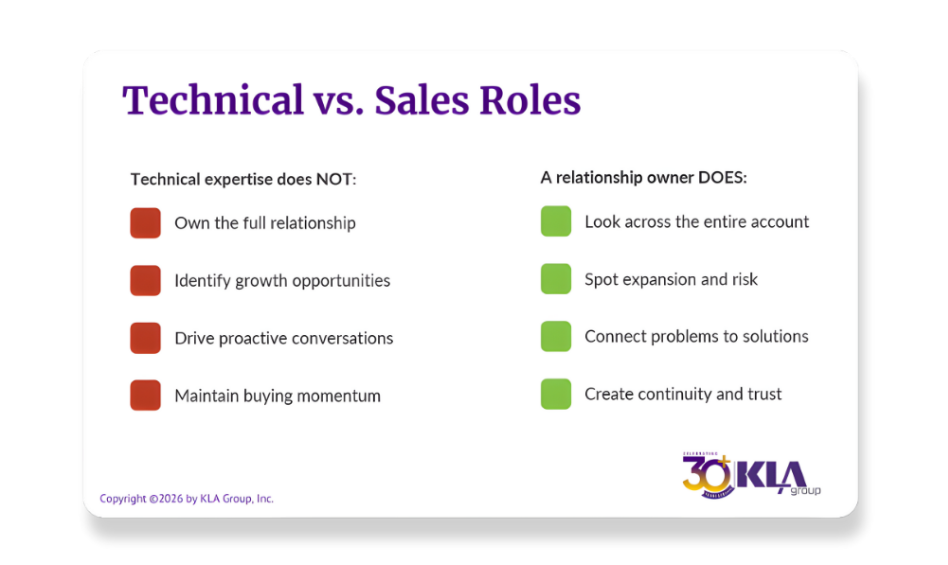
Why shouldn’t technical roles double as sales roles?
Sales requires daily focus, follow-up, and relationship-building. Technical expertise does not replace dedicated selling.
Another common mistake is asking technical experts or consultants to sell.
While technical expertise is valuable, it is not a replacement for a dedicated sales role. Sales requires daily focus on prospecting, relationship building, and follow-up. When sales becomes a part-time responsibility, it becomes a neglected one.
Sales reps should own growth and relationships. Technical experts should support the sales process when needed, not carry the burden alone.
Blurring these roles creates risk, burnout, and missed opportunities.
How does marketing impact a sales rep’s success?
Marketing creates familiarity before outreach begins. That familiarity makes sales conversations warmer and more productive.
Sales reps perform better when prospects recognize your name.
Marketing creates familiarity before outreach ever happens. It provides case studies, credibility, and reinforcement throughout the sales cycle. Without it, sales reps must educate and build trust from scratch every time.
When marketing and sales work together:
- Outreach feels warmer
- Sales cycles shorten
- Reps stay motivated longer
Hiring sales reps without marketing support extends ramp time and increases failure rates.
Why is sales management more than just a quota?
Sales management drives coaching, consistency, and execution. A quota alone does not improve performance.
One of the most overlooked aspects of sales hiring is management.
Sales management is not just setting a number and waiting. It is coaching behaviors, reinforcing process, and helping reps navigate challenges. Consistent coaching dramatically improves performance and retention.
If no one has time to manage sales, sales will manage itself, usually poorly.
How do you know if you’re actually ready to hire sales reps?
If you don’t have the foundation in place, hiring now will cost more than waiting. A broken system cannot support a new rep.
Before hiring sales reps, ask yourself:
- Do we know exactly who we sell to?
- Is our offering clearly defined?
- Does marketing support sales outreach?
- Is someone accountable for coaching sales?
- Is our CRM configured to show what’s working and what’s breaking down?
If the answer is no, hiring now may cost more than waiting.
This is not about delaying growth. It is about protecting it.
Final Takeaways
At KLA Group, we help CEOs strengthen the digital trust signals that power their entire revenue generation system across sales, marketing, CRM, and AI. That way, your team stops chasing disconnected activity and starts generating measurable opportunities.
If you’re thinking about hiring a sales rep, or wondering why your current one isn’t delivering, don’t move forward without knowing if your system is ready to support success. We’ll help you evaluate what’s broken, what’s working, and where to focus first. Schedule a 20-minute consultation.
Frequently Asked Questions
Quick answers to common questions about sales hiring readiness.
Why do sales hires often fail even when the person is experienced?
Sales hires often fail, even when the person is experienced, because the business lacks the structure, targeting, and coaching required to support their success.
What’s the most important thing to have in place before hiring a sales rep?
The most important thing to have in place before hiring a sales rep is a clearly defined ideal client profile, supported by marketing, CRM visibility, and consistent sales coaching.
Should I prioritize hiring a “hunter” salesperson?
You should not prioritize hiring a “hunter” salesperson unless your company already has clear direction, support systems, and sales infrastructure in place to help them succeed.
Can technical staff be responsible for sales?
Technical staff should not be responsible for sales because selling requires full-time focus on prospecting, follow-up, and relationship development, which cannot be done part-time.
How does marketing influence a sales rep’s success?
Marketing influences a sales rep’s success by creating visibility, familiarity, and credibility before outreach begins, which makes conversations warmer and sales cycles shorter.
What role does CRM play in successful sales hiring?
CRM plays a critical role in successful sales hiring by revealing what’s working, where deals stall, and how reps are performing. Without it, sales efforts lack visibility and direction.
About the Author
Revenue generator and founder of KLA Group, Kendra Lee helps small and mid-sized companies grow revenue by getting seen, getting heard, and getting traction with sales, marketing, and AI strategies that cut through the noise. She’s the author of The Sales Magnet with her third book, From Chaos To Revenue, coming April 2026.
Affiliate Disclosure
Some of the links on this page are affiliate links. If you click through and make a purchase or sign up for HubSpot products, KLA Group may receive a commission at no extra cost to you. We recommend only those products and services we truly believe will add value to your business.