
Why Do LinkedIn and HubSpot Work Better Together?
LinkedIn and HubSpot work better together because they connect visibility with ownership.
LinkedIn helps people see you, learn from you, and decide whether they trust you. HubSpot turns that interest into relationships your business actually owns.
Most companies already have both tools in place.
- Sales is active on LinkedIn.
- Marketing is creating content.
- HubSpot is running in the background.
Yet the results don’t match the effort.
What’s missing isn’t activity. It’s clarity into what’s actually creating opportunities, where momentum is breaking down, and how sales and marketing contribute to real movement instead of just motion.
At KLA Group, we see this pattern constantly. When LinkedIn and HubSpot are used together as one trust-building system, teams stop guessing. They can finally see what’s working, what’s broken, and what needs to change to improve productivity across both sales and marketing.
This article breaks down how that system works and why it’s become the foundation of the conversations we’re having with CEOs today.
Key Takeaways
- LinkedIn creates visibility. HubSpot creates ownership.
- Trust must be earned before asking for an email.
- Pillar content powers a scalable lead generation engine.
- Clusters, dots, and FAQs fuel AI visibility and reader engagement.
- Value exchange beats traditional gating.
If This Feels Familiar, You’re Not Alone
Most teams don’t come to us saying, “Our LinkedIn and HubSpot strategy is broken.”
They describe symptoms instead.
You may recognize a few of these:
- LinkedIn engagement is up, but opportunities aren’t.
- Content is being published, but downloads feel inconsistent.
- HubSpot has contacts, but no clear signal of intent.
- Sales is following up, but conversations stall.
- AI tools are being tested but not integrated into daily execution.
According to HubSpot, 89% of B2B marketers use LinkedIn for lead generation, yet only 62% say it produces leads for them effectively. HubSpot
None of these are separate problems. They’re signals that visibility, trust, and ownership aren’t connected yet.
What Is the Value Exchange Principle?
The value exchange principle means your prospect’s email is earned not taken.
When someone offers their email for a download, they expect value equal to or greater than the cost of that exchange.
At KLA Group, we see the best gated content delivering:
- Clear frameworks
- Step-by-step application
- Strategic depth
- Results readers can replicate
If the download doesn’t surpass expectations, trust is broken and so is your nurture path.
What Does Trust-Based Selling Look Like Today?
Trust-based selling teaches before it pitches.
Buyers are educating themselves through social content, not sales decks. They expect conversations, not interrogations.
- Teach before asking.
- Help before offering.
- Listen before positioning.
At KLA Group, we help clients use LinkedIn and CRM tools like HubSpot to warm the relationship with insight so by the time a conversation happens, trust is already built.
What Is the Pillar, Cluster, Dot Framework?
The pillar, cluster, dot framework is a structured way to turn one core idea into consistent, trust-building content across LinkedIn, email, and your CRM.
It helps you earn attention first, then move people into HubSpot because they’ve already learned from you.
This framework was unpacked in a recent Coffee with Kendra conversation with Kendra Lee and LinkedIn expert, Brynne Tillman, where we walked through how trust is built before someone ever gives you their email address and why most teams rush this step.
Here’s How the Pillar, Cluster, Dot Framework Works
Pillar Content
Pillar content is a long-form, downloadable resource that solves one specific buyer problem in depth.
It’s designed to be valuable enough that someone willingly exchanges their email for it.
A strong pillar:
- Solves one clear problem
- Stays relevant over time
- Includes practical steps and frameworks
Gives buyers enough insight to decide whether they can do it themselves or need help.
In the Coffee with Kendra session, Brynne Tillman described pillar content as something people are “buying with their email.” That framing matters because it forces you to raise the bar on what you create.
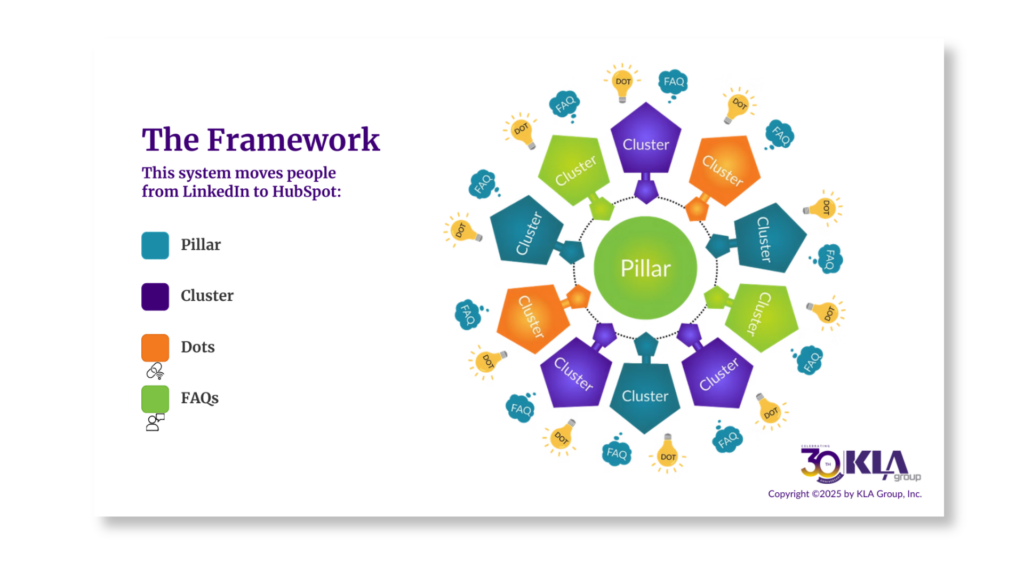
Cluster Content
Cluster content consists of standalone LinkedIn posts pulled directly from your pillar.
Each post delivers a complete insight on its own, without requiring a download to be valuable.
Clusters work because they:
- Prove value before the ask
- Demonstrate how you think
- Set expectations for what’s behind the form
We spent a significant amount of time breaking down what cluster content should, and should not look like, because this is where many teams unintentionally lose trust.
Dot Content
Dot content is short, visual, quote-style content designed to reinforce your message and improve recall.
Each dot delivers one idea, one takeaway, or one moment of clarity.
Dot content helps because it:
- Reinforces your point of view
- Builds recognition over time
- Makes your message easier to remember
Dots don’t replace deeper content. They support it by keeping your ideas visible between longer posts.
FAQ Content
FAQ content answers real buyer questions using natural language that mirrors how people search and ask.
It plays a critical role in both trust-building and AI visibility.
FAQs:
- Extend the life of your pillar
- Improve AEO and AI search visibility
- Answer buyer questions clearly and directly
- Create additional LinkedIn and blog content without starting from scratch
Watch the full Coffee with Kendra session with Brynne Tillman to see this framework explained visually, with real examples and practical guidance.
How Do You Turn LinkedIn Engagement into Owned Audiences?
Visibility doesn’t drive revenue. Ownership does.
Use LinkedIn to guide interested readers to next steps:
- Download the guide
- Register for a webinar
- Subscribe to your email series
Tips to increase owned engagement:
- Place links in context (not dumped at the end)
- Send posts directly to qualified contacts, not mass tagged
- Personalize follow-up via direct messages with permission
Once they click, HubSpot picks up the conversation.
How Do You Nurture in HubSpot Without Selling Too Soon?
HubSpot lets you guide, not push, buyers.
The biggest mistake we see is pitching immediately after a download.
Instead, high-performing nurture sequences:
- Expand on the pillar ideas
- Guide readers through frameworks
- Segment by behavior and role
- Invite, don’t assume, sales readiness
This is where sales, marketing, CRM, and AI must work as one system. HubSpot tracks signals. You respond with value.
How Can You Increase Your Reach Without Gaming the Algorithm?
Reach follows relevance not tricks.
KLA clients often ask how to “boost engagement,” but the real question is:
“Who are you trying to reach, and how are you proving value?”
To increase visibility:
- Engage with buyer-relevant posts
- Use company pages strategically
- Collaborate with referral partners
- Join conversations happening in your industry
- Don’t chase clicks. Earn conversations.
How Do You Turn Content Into Sales Conversations?
Conversations create opportunities, not just content.
When someone responds to a post or downloads a guide, your first question isn’t “Are you ready to buy?” It’s:
“What resonated with you?”
Build conversations around:
- Buyer context
- Recent challenges
- Insights from your content
- Questions they haven’t found answers to
KLA teaches our clients to start from curiosity and insight, not offers and pricing.
How Does This Framework Support AEO and AI Search?
AEO (Answer Engine Optimization) makes your content visible in AI tools like Google SGE, ChatGPT, and Bing Copilot.
This framework supports AEO by:
- Using FAQ structures that match AI queries
- Starting sections with clear answers
- Structuring content with bolded terms and short paragraphs
- Linking questions to real buyer pain
At KLA Group, we help you build content engines that answer questions and generate conversations.
What Are the Most Common Mistakes to Avoid?
- Gating content that lacks depth
- Pitching immediately after a download
- Treating automation like a substitute for trust
- Tagging people who didn’t ask
- Broadcasting instead of conversing
Final Summary
Here’s what this strategy helps you do:
- Use LinkedIn to build early-stage trust
- Move contacts into HubSpot with intentional content
- Create pillar + cluster + dot content that fuels AI visibility
- Nurture with education, not pressure
- Turn insights into sales-qualified conversations
Final Thoughts
If you’re ready to turn social engagement into a trust-based revenue system, this framework is your starting point.
KLA Group helps companies between $1M–$100M in annual revenue unify sales, marketing, CRM, and AI into one system that consistently creates real movement. If you want to strengthen trust on LinkedIn and convert early-stage interest into measurable opportunity movement inside HubSpot, we can help. Schedule a 20-minute consultation.
FAQs: LinkedIn, HubSpot & Trust-Based Pipeline Growth
Quick answers to common questions about turning LinkedIn visibility into trusted HubSpot relationships and measurable opportunity movement.
How do LinkedIn and HubSpot work together for B2B sales?
LinkedIn and HubSpot work together by combining visibility and trust with ownership. LinkedIn builds trust and engagement early, while HubSpot captures, tracks, and nurtures that interest into measurable sales opportunities.
Why isn’t LinkedIn engagement turning into sales opportunities?
LinkedIn engagement often fails to turn into opportunities because visibility is not connected to ownership. Without a clear path into HubSpot or another CRM, interest remains social activity instead of sales momentum.
How does HubSpot help convert LinkedIn engagement into revenue?
HubSpot converts LinkedIn engagement into revenue by tracking behavior, segmenting contacts, and nurturing buyers with relevant content. This allows sales teams to follow up with context instead of cold outreach.
What is a trust-based revenue engine?
A trust-based revenue engine is a system where buyers learn from content before entering a sales conversation. It prioritizes education, value exchange, and timing so opportunities move forward with confidence instead of pressure inside a revenue generation system.
What type of content works best for LinkedIn and HubSpot together?
Pillar content supported by cluster posts, short-form insights, and FAQs works best. This structure builds trust on LinkedIn while giving HubSpot meaningful assets to nurture buyers over time.
How does this content strategy support AI search and AEO?
This strategy supports AEO by using question-based content, clear answers, and structured frameworks that AI search tools understand, trust, and reuse your expertise.
What is the biggest mistake companies make using LinkedIn and HubSpot?
The biggest mistake is selling too early. When teams rush from engagement to pitch, they break trust. A better approach is using LinkedIn to educate first and HubSpot to nurture interest before sales outreach.
What is the main benefit of using LinkedIn and HubSpot together?
LinkedIn builds visibility and trust, while HubSpot turns that trust into owned relationships you can nurture. At KLA Group, we use LinkedIn to earn attention and HubSpot to track, segment, and convert that interest into measurable opportunities across sales and marketing.
Why does trust matter before asking for an email address?
An email address is a value exchange, not a free action. Buyers give their email only when they trust the content will be worth it. KLA Group teaches teams to earn that trust on LinkedIn first, so email engagement starts strong instead of feeling intrusive.
How often should a company create pillar content?
Most companies succeed with one pillar per month, supported by clusters, dots, and FAQs. This cadence creates consistent visibility without overwhelming the team. At KLA Group, we use this rhythm to fuel LinkedIn engagement and HubSpot nurturing simultaneously.
What is the pillar, cluster, and dot content framework?
The framework turns one idea into a scalable content engine. A pillar is a deep, gated asset. Clusters are standalone LinkedIn posts derived from it. Dots are short, memorable insights. Together, they build trust before conversion.
How does this approach improve HubSpot performance?
When contacts enter HubSpot after engaging on LinkedIn, they are already informed and interested. This leads to higher open rates, better segmentation, and more productive follow-up. KLA Group uses HubSpot as a visibility tool to see what content actually creates momentum.
How does this content strategy support AEO and AI search?
FAQs, clear headings, and answer-first content match how AI tools and voice search engines surface answers. This structure increases visibility in AI summaries and featured snippets. KLA Group designs content to perform for both human readers and AI engines.
What is the biggest mistake companies make with LinkedIn and HubSpot?
The biggest mistake is selling too soon. Many teams rush from connection to pitch, skipping trust-building. KLA Group helps companies slow down early, so opportunities move faster later with better fit and higher confidence.
About the Author
Revenue generator and founder of KLA Group, Kendra Lee helps small and mid-sized companies grow revenue by getting seen, getting heard, and getting traction with sales, marketing, and AI strategies that cut through the noise. She’s the author of The Sales Magnet , with her third book, From Chaos To Revenue, coming in 2026.
Read More Related Articles